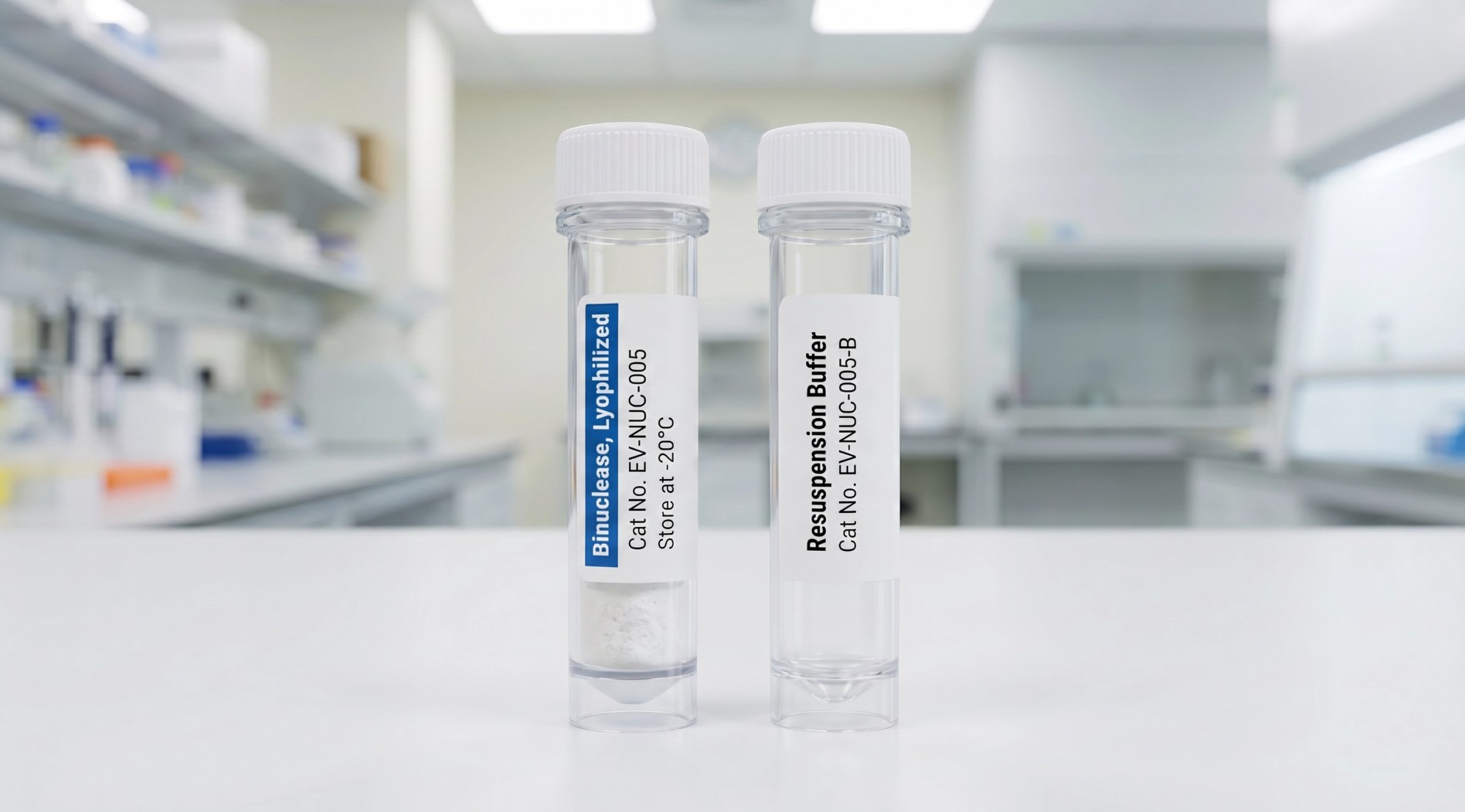
Binuclease
Enzovera Binuclease is a recombinant non-specific endonuclease functionally equivalent to Serratia marcescens nuclease, available in two formats: EV-NUC-005 (Lyophilized, ≥20 kU/mg, 100 KU/tube) and EV-NUC-006 (Solution, ≥250 U/µL, 100 KU/tube). Binuclease degrades all forms of nucleic acid — single-stranded DNA, double-stranded DNA, single-stranded RNA, and double-stranded RNA — with no sequence preference, making it the standard reagent for nucleic acid clearance in biopharmaceutical manufacturing, recombinant protein production, and bioprocess downstream operations.
Mechanism. Binuclease is a non-specific phosphodiesterase (EC 3.1.30.2) that hydrolyzes the phosphodiester backbone of any nucleic acid substrate regardless of sequence, strandedness, or secondary structure. Active as a homodimer of two identical 30 kDa subunits, the enzyme requires Mg²⁺ or Mn²⁺ as cofactors and is optimally active at pH 6–9 and 0–42°C. It is compatible with common lysis buffer components including Triton X-100, Tween-20, and CHAPS, but is inhibited by EDTA and DTT concentrations above 20 mM. Unlike restriction endonucleases or substrate-selective nucleases, Binuclease degrades all nucleic acid forms to mononucleotides and short oligonucleotides within minutes of addition — a completeness of degradation essential for viscosity reduction and regulatory-grade DNA clearance.
Bioprocessing application. During recombinant protein expression in E. coli, yeast, insect, or mammalian cell systems, nucleic acids released from lysed cells dramatically increase lysate viscosity, impeding clarification, filtration, and chromatography. A single addition of Binuclease (1–10 U/ml final) to the cell lysate reduces DNA and RNA to short oligonucleotides in 15–30 minutes at room temperature, lowering viscosity by orders of magnitude and enabling efficient downstream processing without mechanical shearing. Host-cell DNA removal is also a regulatory requirement in biopharmaceutical manufacturing for biologics, viral vectors, and vaccines, where residual DNA must be reduced to accepted safety thresholds.
Recommended applications:
- Viscosity reduction of bacterial, yeast, insect, or mammalian cell lysates during recombinant protein purification
- Host-cell DNA removal from biopharmaceutical production streams to regulatory thresholds
- Clarification of viral vector preparations (AAV, adenovirus, lentivirus) for gene therapy manufacturing
- Nucleic acid clearance in subunit vaccine antigen production
- DNA and RNA removal from inclusion body solubilization and refolding reactions
- Removal of nucleic acid contamination from protein crystallography samples
- Preparation of nucleic-acid-free protein standards and calibration reference materials