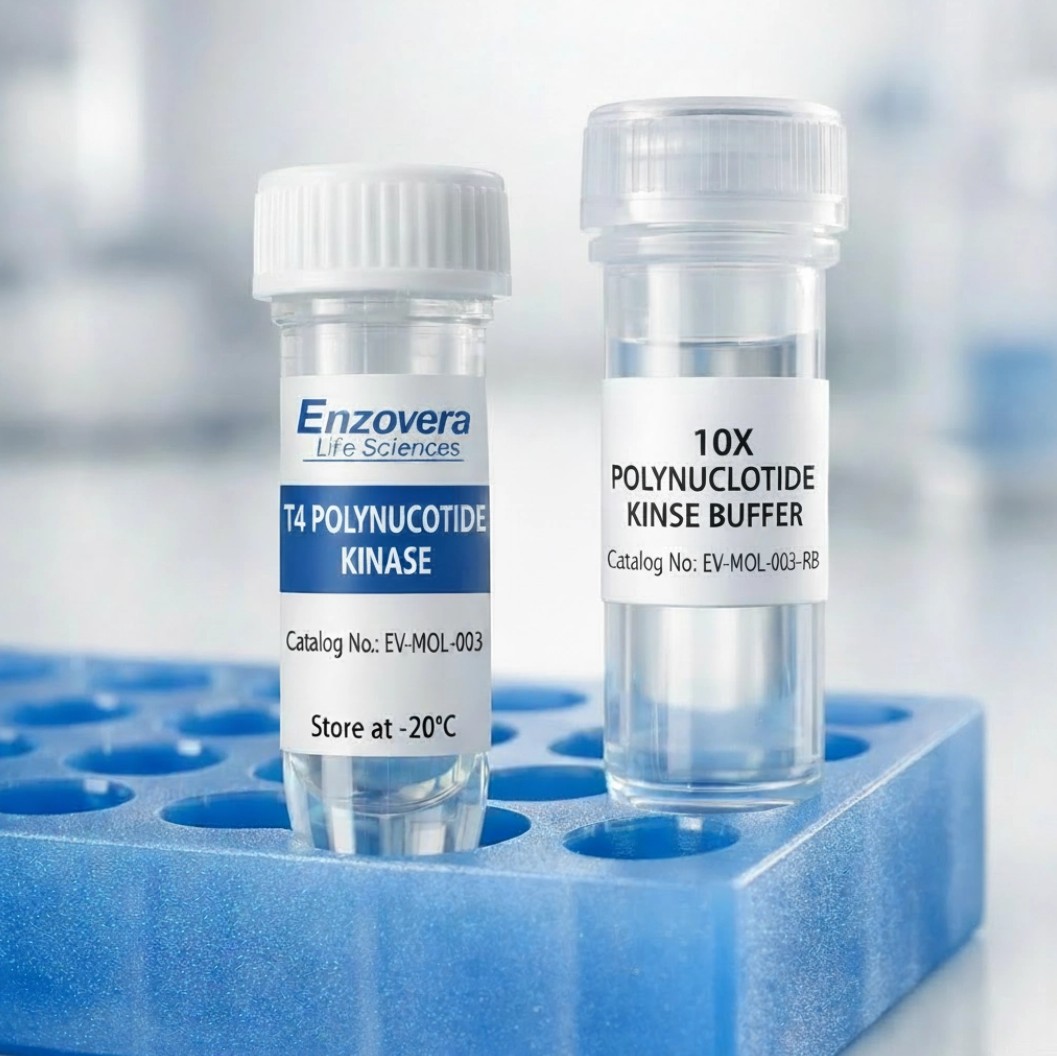
T4 Polynucleotide Kinase (T4 PNK)
Enzovera T4 Polynucleotide Kinase (EV-MOL-003) is a recombinant bifunctional enzyme produced in E. coli Rosetta(DE3) from the cloned bacteriophage T4 pseT gene. It is the most widely used enzyme for nucleic acid 5′-end processing in molecular biology, essential for phosphorylating synthetic oligonucleotides, radiolabeling DNA and RNA termini, and preparing nucleic acid substrates for ligation and sequencing.
Dual enzymatic activities. T4 PNK possesses two completely independent catalytic activities housed in a single polypeptide chain. The 5′-kinase activity catalyzes the ATP-dependent transfer of the γ-phosphate group of ATP to the 5′-hydroxyl terminus of single- or double-stranded DNA and RNA, as well as nucleoside 3′-monophosphates. This forward kinase reaction is the basis of 5′-end radiolabeling with [γ-³²P]-ATP and phosphorylation of synthetic oligonucleotides prior to ligation. The 3′-phosphatase activity catalyzes the removal of 3′-phosphate groups from DNA and RNA termini in an ADP-dependent (or ADP-independent at alkaline pH) reaction — a critical preparatory step for substrates generated by certain restriction enzymes, RNA polymerases, or chemical fragmentation methods that leave non-ligatable 3′-phosphate ends.
Oligomeric structure and stability. T4 PNK is active as a homotetramer (~132 kDa) assembled from four identical 33 kDa subunits. The tetrameric assembly is required for full catalytic activity. Low-temperature induction during expression (20°C) is essential for correct tetramer formation. The enzyme is stable in 50% glycerol at −20°C for 24 months and is not significantly inhibited by BSA, DTT, or common ligation buffer components. Activity is inhibited by >50 mM ammonium sulfate, phosphate, and high concentrations of inorganic pyrophosphate.
End-repair for NGS. In next-generation sequencing library preparation, sheared or fragmented DNA typically contains a mixture of 5′-OH, 5′-phosphate, 3′-OH, and 3′-phosphate termini. T4 PNK corrects both the absent 5′-phosphate (via kinase activity) and the non-ligatable 3′-phosphate (via phosphatase activity) in a single reaction, converting all termini to the 5′-phosphate / 3′-OH configuration required for efficient adapter ligation by T4 DNA Ligase (EV-MOL-001). For complete NGS end-repair, pair T4 PNK with T4 DNA Polymerase (EV-MOL-002) to simultaneously blunt ragged ends.
Recommended applications:
5′-end radiolabeling of DNA and RNA with [γ-³²P]-ATP for gel-shift assays, footprinting, and hybridization probes
Phosphorylation of synthetic oligonucleotides for ligation, annealing into duplexes, or primer extension
NGS library end-repair (combined 5′-phosphorylation and 3′-phosphate removal)
Removal of 3′-phosphate groups to generate ligatable 3′-OH termini
Preparation of RNA substrates for T4 RNA ligase-based workflows
Exchange reaction labeling of pre-phosphorylated 5′ termini using [γ-³²P]-ATP and ADP