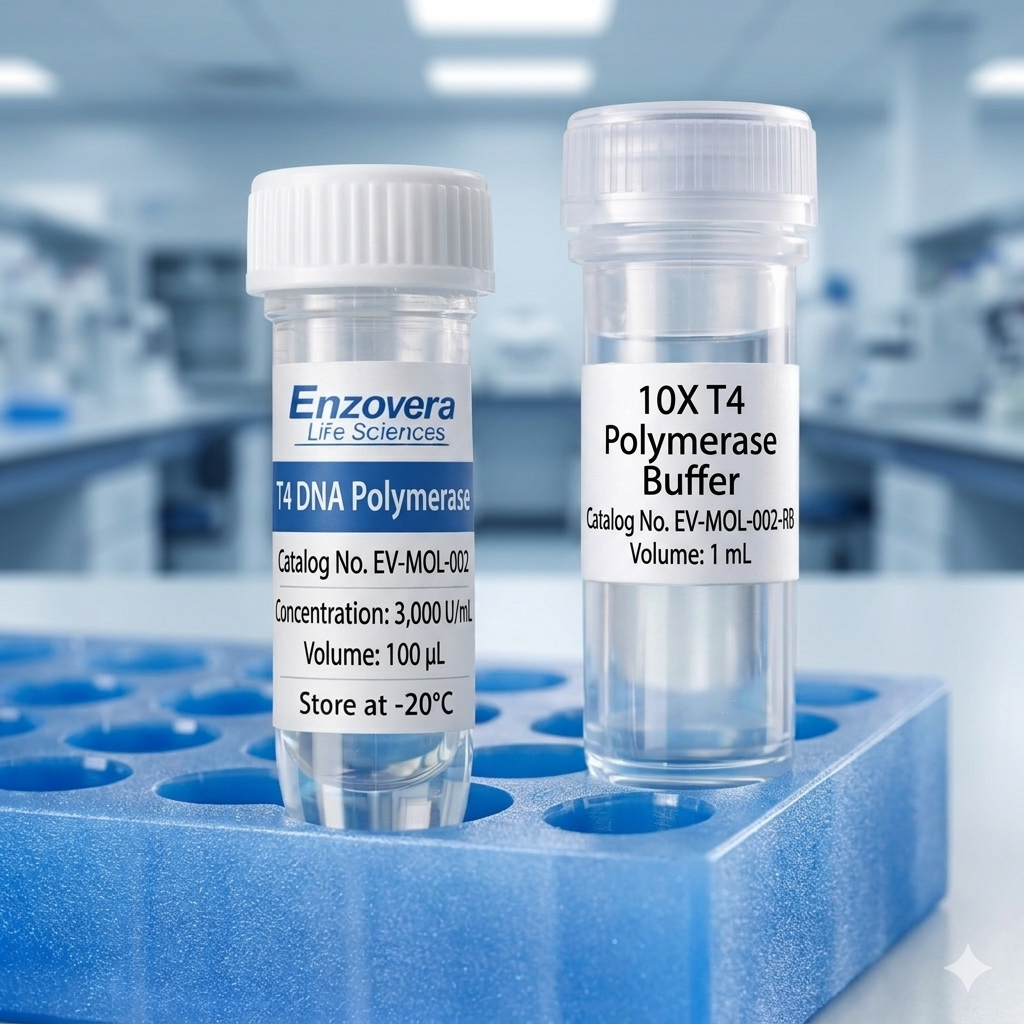
T4 DNA Polymerase
Enzovera T4 DNA Polymerase (EV-MOL-002) is a recombinant enzyme produced in E. coli Rosetta(DE3) from the cloned bacteriophage T4 gene 43. It is a template-directed, processive DNA polymerase uniquely characterized by an exceptionally powerful 3′→5′ exonuclease activity — approximately 200-fold stronger than that of E. coli DNA Polymerase I — which makes it the definitive choice for precision DNA end-processing applications.
Activities and properties. T4 DNA Polymerase (T4 Pol) possesses two intrinsic and competing enzymatic activities: a 5′→3′ polymerase that extends a primed template with high processivity, and a highly active 3′→5′ exonuclease (proofreading exonuclease) that degrades from the 3′ terminus of single- or double-stranded DNA. The enzyme critically lacks both 5′→3′ exonuclease activity and strand displacement — the two properties that distinguish it from DNA Pol I and allow it to act with extreme precision on defined DNA termini. The balance between polymerase and exonuclease activities is controlled by dNTP concentration: in the absence of dNTPs, the exonuclease activity dominates completely, producing controlled 3′-recessed substrates for downstream applications such as ligation-independent cloning (LIC).
End-blunting. The most common application of T4 DNA Polymerase is the generation of perfectly blunt-ended DNA from substrates with either 5′ overhangs or 3′ overhangs. In fill-in mode (all four dNTPs present), the polymerase fills in 5′-recessed ends. In chew-back mode (limiting or absent dNTPs), the exonuclease removes 3′ overhangs. When dNTPs are present at low, balanced concentrations, the polymerase-exonuclease equilibrium naturally generates blunt ends regardless of the starting terminus geometry. The blunt-end product can then be ligated with T4 DNA Ligase (EV-MOL-001) or phosphorylated for blunt cloning using T4 PNK (EV-MOL-003).
LIC cloning. In ligation-independent cloning, T4 Pol is used with a single defined dNTP species (e.g., dCTP only). The exonuclease chews back the 3′ terminus until it reaches the first cytosine residue (on the complementary strand), where the polymerase-exonuclease equilibrium halts. This creates long, defined single-stranded 5′ overhangs that are complementary to vector-end overhangs generated the same way — enabling sequence-specific, directional cloning without restriction enzymes or ligation.
Recommended applications:
End-blunting of PCR products or restriction fragments prior to blunt-end cloning or ligation
Ligation-independent cloning (LIC) via controlled 3′ chew-back
NGS library end-repair (pair with T4 PNK EV-MOL-003 for complete end-repair)
Generation of 3′-recessed substrates for exonuclease-based assays
Radiolabeling of DNA probes via 3′-end replacement (exchange labeling)
Generation of defined single-stranded regions for structure-function studies
Important note: T4 DNA Polymerase is a mesophilic enzyme (optimal at 37°C). Do not use heat treatment steps in downstream processing. Inactivate with 10 mM EDTA at 75°C for 20 minutes or purify ligation product directly through a spin column.