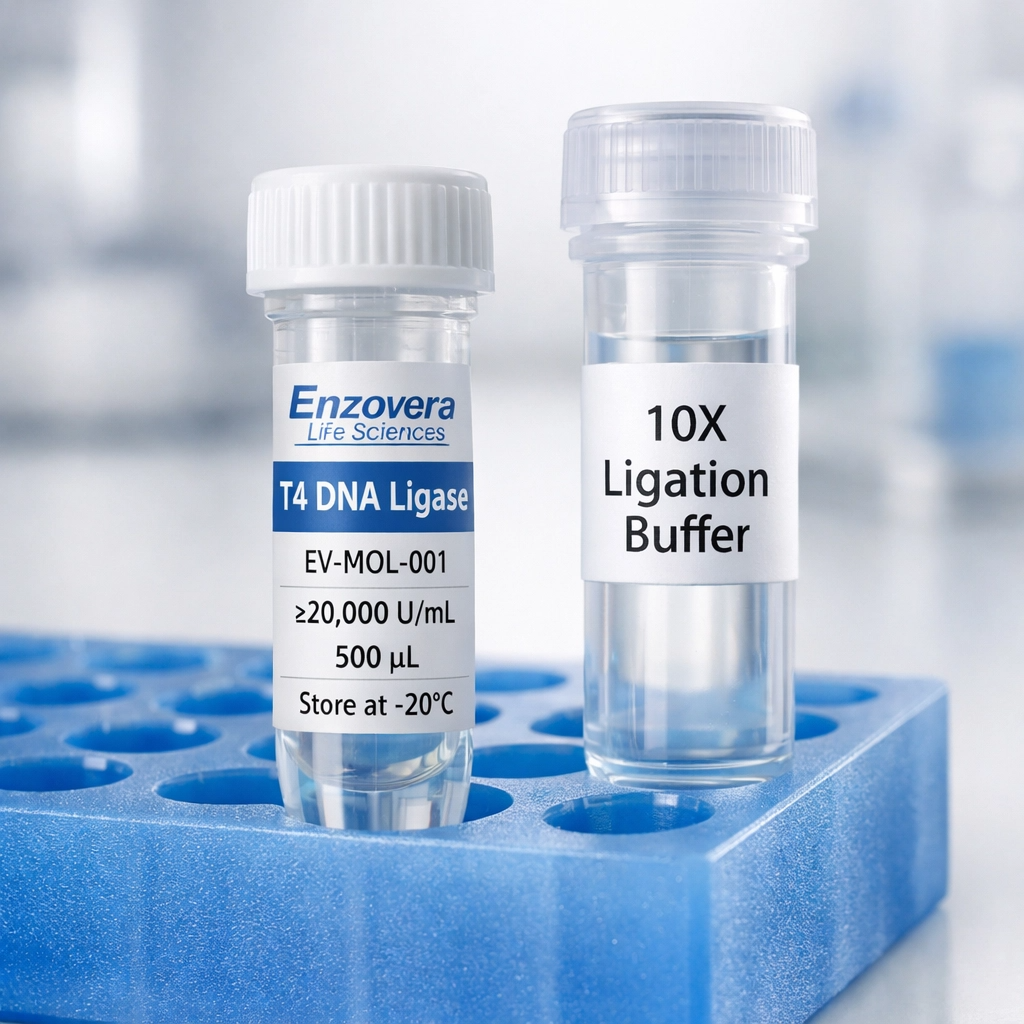
T4 DNA Ligase
Enzovera T4 DNA Ligase (EV-MOL-001) is a recombinant, research-grade enzyme produced in E. coli BL21(DE3) from the cloned bacteriophage T4 gene 30. It is an ATP-dependent phosphodiesterase that catalyzes the covalent joining of adjacent 5′-phosphate and 3′-hydroxyl termini in duplex DNA — the fundamental nick-sealing reaction that underlies virtually every recombinant DNA workflow in use today.
Mechanism. The reaction proceeds in three tightly coordinated steps. First, the enzyme reacts with ATP to form a covalent enzyme-AMP intermediate at Lys-159 (enzyme adenylation), releasing pyrophosphate. Second, the activated AMP is transferred to the 5′-phosphate of the DNA strand, forming a DNA-adenylate intermediate. Third, the 3′-hydroxyl of the opposing strand attacks the activated phosphate, displacing AMP and sealing the phosphodiester backbone. All three steps require Mg²⁺ as a cofactor. The enzyme is completely inactivated by heat treatment at 65°C for 10 minutes or 70°C for 5 minutes, and by chelation of Mg²⁺ with EDTA — both properties that allow clean downstream processing of ligation products.
Substrate versatility. Unlike NAD⁺-dependent ligases such as E. coli DNA ligase, T4 DNA Ligase efficiently joins both cohesive (sticky) ends and blunt ends, and seals single-strand nicks in duplex DNA, RNA:DNA hybrids, and double-stranded RNA. Cohesive-end ligation is highly efficient under standard conditions (16°C, 16 hours, or 25°C rapid protocol). Blunt-end ligation proceeds at moderate efficiency and benefits from higher enzyme concentration (5–10× standard), PEG-4000 as a molecular crowding agent, and overnight incubation at 16°C. Nick-sealing activity at 37°C makes this enzyme suitable for nick-repair applications including the assembly of synthetic genes and repair of damaged DNA substrates.
Formulation and quality. Each lot of EV-MOL-001 is purified to ≥95% homogeneity by multi-step chromatography (Ni-NTA IMAC followed by heparin affinity polishing) and rigorously quality-controlled before release. QC testing includes SDS-PAGE purity assessment, ligation activity on HindIII-digested lambda DNA (cohesive ends) and SmaI-linearized pUC19 (blunt ends), exonuclease and endonuclease contamination assays (4 hours, 37°C), RNase fluorescence assay, host genomic DNA contamination by qPCR (<10 copies per µg protein), and endotoxin by LAL (<1.0 EU/mg). Lot-to-lot specific activity is controlled to within ±15% of the Enzovera reference lot.
Recommended applications:
Routine directional and non-directional cloning of restriction-digested fragments into vectors
Adapter and linker ligation for next-generation sequencing library construction
Gibson Assembly nick-sealing step
Single-strand nick repair in circular plasmids following site-directed mutagenesis
Blunt-end cloning of PCR products (pair with T4 DNA Polymerase EV-MOL-002 for end-blunting)
RNA-splint ligation and RNA:DNA hybrid junction sealing
Supplied with: 10× T4 DNA Ligase Buffer (EV-MOL-001-LB): 500 mM Tris-HCl pH 7.6, 100 mM MgCl₂, 100 mM DTT, 10 mM ATP. Store at −20°C. Stable for 12 months in single-use aliquots. Do not autoclave.