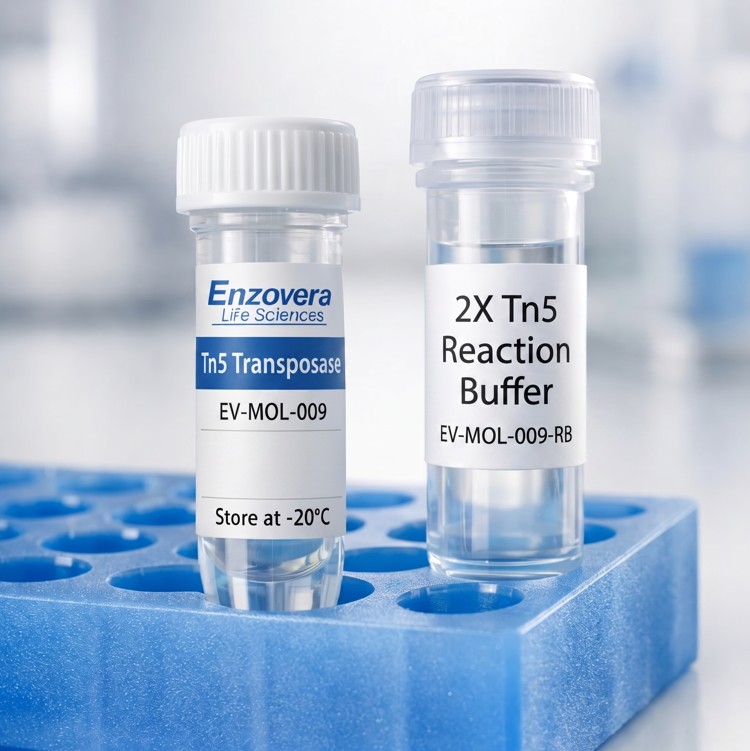
Tn5 Transposase
Enzovera Hyperactive Tn5 Transposase (EV-MOL-009) is a recombinant, tagmentation-grade enzyme produced in E. coli Rosetta(DE3) carrying the hyperactive E54K and L372P mutations. These two substitutions disrupt Tn5's natural self-inhibition mechanism, increasing the rate of transposition by more than 1,000-fold relative to wild-type Tn5 Transposase. Pre-loaded with custom mosaic end (ME) adapter oligonucleotides, this enzyme is the active component in tagmentation reactions that simultaneously fragment double-stranded DNA and ligate sequencing adapters in a single enzymatic step — enabling next-generation sequencing library preparation in minutes from nanogram quantities of DNA.
Mechanism of tagmentation. Tagmentation exploits the cut-and-paste transposition mechanism of the DDE-class Tn5 Transposase. The enzyme forms a synaptic complex with two ME-adapter–loaded transposon ends, then catalyzes simultaneous double-strand cleavage of the target DNA at a staggered cut site (9 bp stagger) and covalent strand transfer, inserting the adapter sequence into the target. This generates tagmented fragments with adapter sequences at both ends, separated by a 9-nucleotide gap that is filled in and repaired during subsequent PCR amplification. The reaction produces a library-ready mixture of 150–2,000 bp fragments (mean ~400 bp), with adapter sequences ready for Illumina sequencing primers — all in a 55°C, 5-minute reaction.
Tagmentation efficiency and input flexibility. Hyperactive Tn5 Transposase is active on nanogram quantities of double-stranded DNA (typically 1–50 ng), enabling library preparation from low-input samples including single cells, rare cell populations, limited chromatin immunoprecipitates, and precious clinical specimens. The transposase shows no significant sequence preference beyond the weak Tn5 consensus (virtually unbiased), ensuring even coverage across AT-rich and GC-rich genomic regions. Fragment size distribution is controlled by adjusting the enzyme-to-DNA ratio: higher enzyme concentration generates shorter fragments; lower concentration generates longer fragments.
Adapter compatibility and customization. The enzyme must be pre-loaded with ME (Mosaic End) adapter sequences prior to tagmentation. EV-MOL-009 is supplied as apo-enzyme (without pre-loaded adapters) to allow users to load their own custom adapter sequences, providing full flexibility for dual-index Illumina workflows, custom barcode strategies, single-cell indexing (e.g., sci-ATAC-seq, SHARE-seq), and non-Illumina sequencing platforms. The enzyme is compatible with standard Nextera-style ME sequences and all published ATAC-seq, CUT&Tag, and Omni-ATAC adapter designs.
Recommended applications:
ATAC-seq (Assay for Transposase-Accessible Chromatin) for genome-wide chromatin accessibility profiling
Nextera-compatible NGS library preparation from purified genomic DNA
CUT&Tag for genome-wide mapping of histone modifications and transcription factor binding
ChIP-seq with tagmentation (ChIPmentation)
Single-cell ATAC-seq (sci-ATAC-seq, 10× Genomics ATAC compatible)
Omni-ATAC and Fast-ATAC protocols for frozen tissues and difficult-to-lyse cells
Low-input WGS library preparation from rare or degraded DNA samples
Storage and handling: Hyperactive Tn5 Transposase is sensitive to repeated freeze-thaw. Aliquot upon receipt into single-use volumes. Store at −20°C in the supplied 10% glycerol formulation. The enzyme is inhibited by SDS, EDTA (>1 mM), and high detergent concentrations — ensure all cell lysis and nuclear extraction buffers are compatible with the supplied 2× Tagmentation Buffer before proceeding. Stop the tagmentation reaction by addition of Stop Buffer (provided) and heat inactivation at 70°C for 10 minutes.