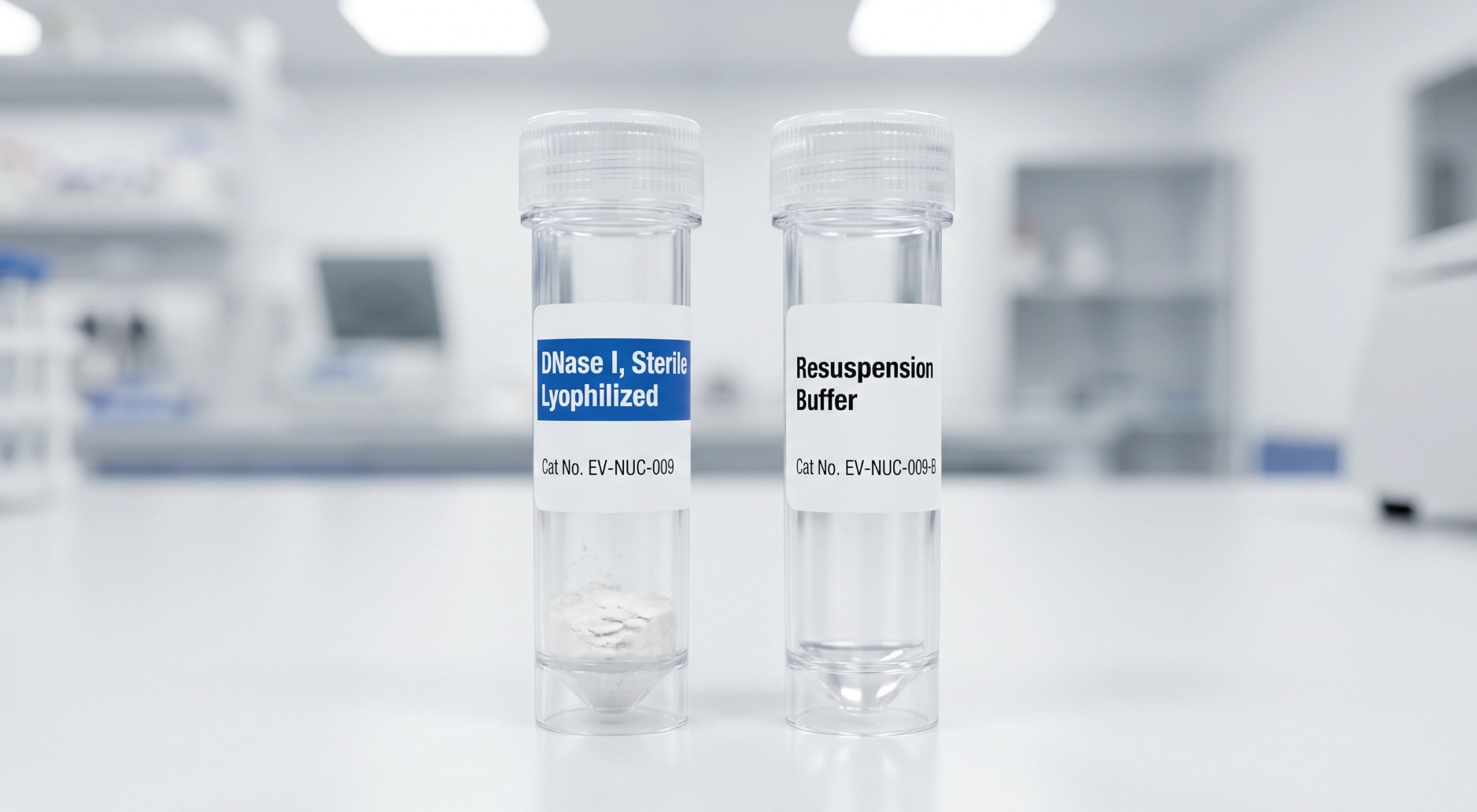
DNase I
Enzovera DNase I (EV-NUC-009) is a sterile lyophilized, high-purity bovine pancreatic deoxyribonuclease I of >90% purity, supplied at 5 KU/tube. DNase I is the standard endonuclease for complete digestion of both single-stranded and double-stranded DNA, and is indispensable wherever DNA contamination must be eliminated without compromising co-purified RNA, proteins, or other biological materials. The sterile lyophilized format ensures compatibility with cell culture–sensitive workflows and provides long-term storage stability.
Mechanism. DNase I (EC 3.1.21.1) is a non-specific endonuclease that hydrolyzes phosphodiester bonds in the DNA backbone to generate fragments bearing 5′-phosphate and 3′-hydroxyl termini — the precise ends required for downstream enzymatic processing including end-repair, adapter ligation, and PCR amplification. The enzyme degrades both double-stranded and single-stranded DNA, as well as the DNA strand of RNA:DNA hybrids. DNase I absolutely requires divalent cations: in the presence of Mg²⁺ alone, the enzyme introduces double-strand cuts approximately at random; when both Mg²⁺ and Ca²⁺ are present, single-strand nicking predominates. EDTA completely and immediately inactivates DNase I by chelating the metal cofactors. Heat inactivation (65°C, 10 minutes, 2.5 mM EDTA) provides an alternative stop method.
DNA removal from RNA preparations. The dominant application of DNase I in modern molecular biology is removal of residual genomic DNA from RNA preparations prior to RT-PCR, RT-qPCR, and RNA-seq library construction. Even trace genomic DNA contamination can produce false-positive amplification signals, particularly when primers span exonic regions without intron-crossing architecture. Both on-column DNase I digestion during column-based RNA purification and in-solution treatment at 37°C for 30 minutes completely eliminate trace DNA while leaving RNA intact — RNA is not a DNase I substrate under physiological conditions. Beyond RNA cleanup, DNase I is essential for DNase-seq chromatin accessibility mapping, DNase I footprinting, and nick translation probe labeling in combination with DNA Polymerase I.
Recommended applications:
- On-column and in-solution elimination of genomic DNA from total RNA preparations
- Preparation of DNA-free RNA for RT-PCR, RT-qPCR, and RNA-seq library construction
- Nick translation probe preparation in combination with DNA Polymerase I
- DNase I footprinting to map protein-DNA interaction and binding sites
- Chromatin accessibility mapping by DNase-seq
- Removal of DNA template after in vitro transcription reactions
- Generation of random DNA fragments for next-generation sequencing library construction