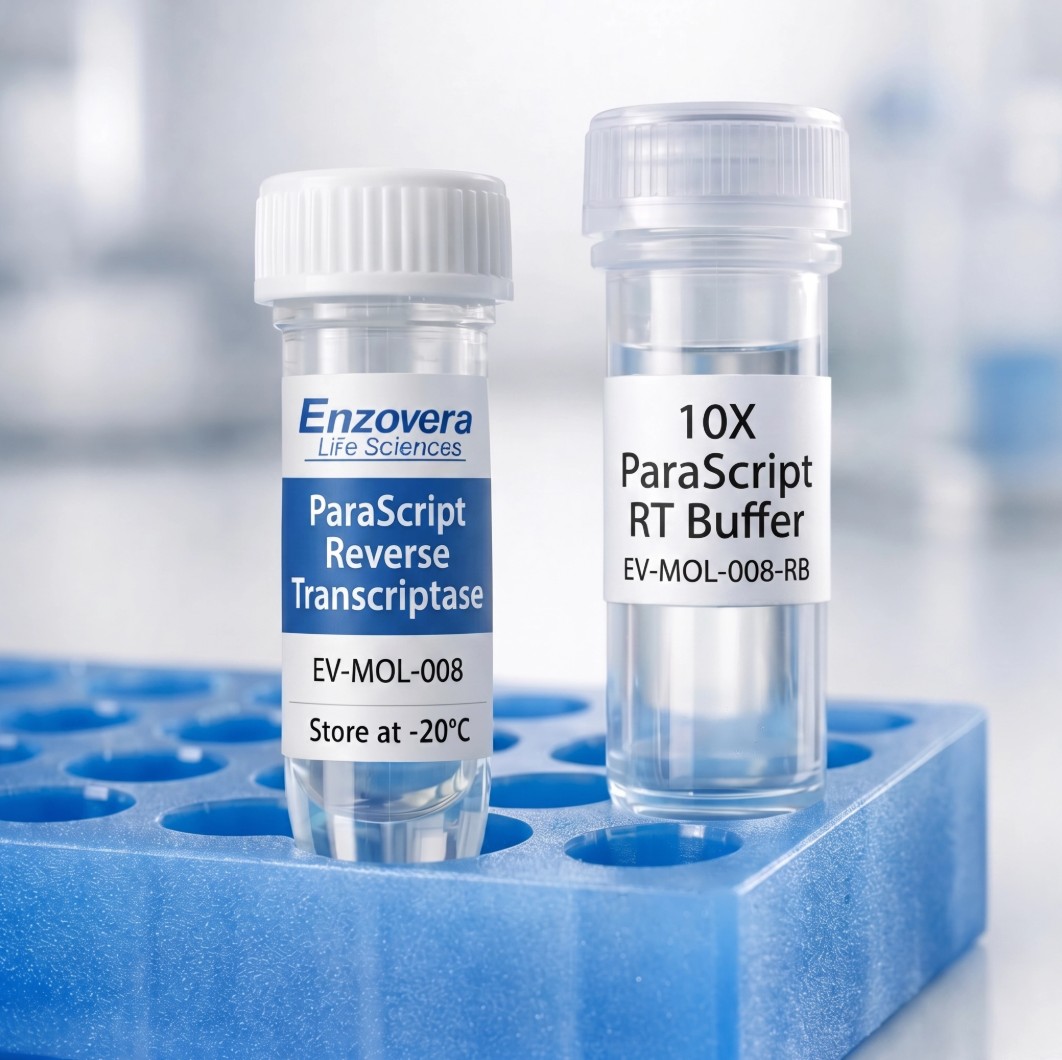
ParaScript Reverse Transcriptase
EV-MOL-008 Enzovera ParaScript Reverse Transcriptase (EV-MOL-008) is an engineered Moloney Murine Leukemia Virus Reverse Transcriptase (MMLV-RT) produced in E. coli Rosetta(DE3). Through the introduction of four thermostabilizing mutations (R116K, D200N, T330P, L603W) and a RNase H-attenuating mutation (D524A), ParaScript RT extends the operational temperature window of MMLV-RT from 37°C up to 55°C while maintaining full polymerase activity and significantly improving processivity on difficult RNA templates including those with extensive secondary structure, high GC content, and long 5′ untranslated regions.
Thermostability and secondary structure resolution. Wild-type MMLV-RT operates optimally at 37–42°C — a temperature at which stable RNA secondary structures including hairpins, G-quadruplexes, and pseudoknots remain partially folded and impede reverse transcription, leading to premature termination and truncated cDNA products. ParaScript RT retains full activity at 42–55°C, a temperature range that denatures most secondary structures that would otherwise constitute roadblocks. For especially difficult templates, a temperature ramp protocol (42°C for 15 minutes, then 50°C for 30 minutes) can further improve full-length cDNA yield without compromising RNA template integrity.
Reduced RNase H activity. MMLV-RT naturally possesses RNase H activity that degrades the RNA strand of an RNA:DNA hybrid as the cDNA is synthesized. While some RNase H activity aids template clearance and promotes second-strand priming in double-stranded cDNA synthesis, excessive RNase H activity can degrade the RNA template before full-length reverse transcription is complete, particularly on long mRNA templates. The D524A mutation in ParaScript RT reduces RNase H activity by approximately 90% while retaining sufficient residual activity for efficient template clearance. This allows synthesis of full-length cDNA from mRNA templates exceeding 10 kb with substantially higher yield than wild-type MMLV-RT.
One-step RT-PCR compatibility. ParaScript RT is fully compatible with one-step RT-PCR workflows in which reverse transcription and PCR amplification occur in a single tube sequentially. The enzyme is inhibited at standard PCR denaturation temperatures (>70°C), allowing the PCR polymerase (EV5™, EV-MOL-007, or Pfu, EV-MOL-006) to take over after the RT step without enzyme removal. Optimal one-step conditions: 50°C, 30 minutes RT; 95°C, 2 minutes inactivation; then standard PCR cycling.
Recommended applications:
Two-step RT-PCR: first-strand cDNA synthesis followed by PCR amplification
One-step RT-PCR in a single-tube, single-reaction format
Full-length cDNA synthesis from mRNA templates including those with high GC content or secondary structure
cDNA library construction from total RNA or poly(A)+ RNA
Gene expression quantification by RT-qPCR
RACE (Rapid Amplification of cDNA Ends)
Transcriptome sequencing library preparation (RNA-seq)
Primer options: ParaScript RT is compatible with oligo(dT) primers (for polyadenylated mRNA), random hexamers (for total RNA or rRNA-depleted samples), and gene-specific primers (for targeted cDNA synthesis). For highest specificity in gene expression analysis, gene-specific reverse primers are recommended. For full-length cDNA library construction, oligo(dT) with a defined anchor sequence is preferred.