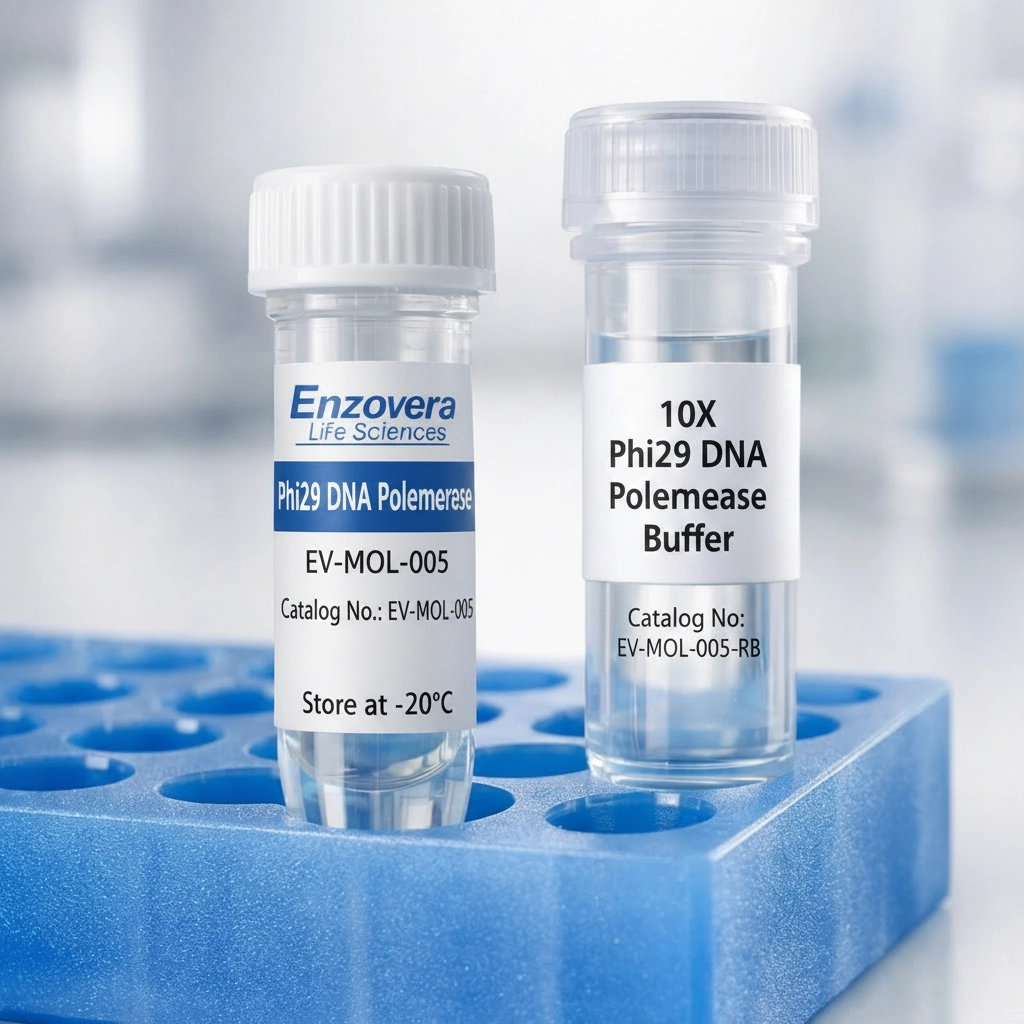
Phi29 DNA Polymerase
Enzovera Phi29 DNA Polymerase (EV-MOL-005) is a recombinant, research-grade enzyme produced in E. coli Rosetta(DE3) from the cloned bacteriophage phi29 DNA polymerase gene. It is among the most extraordinary DNA polymerases known — combining an unrivaled degree of processivity (>70 kilobases per single binding event), a powerful strand displacement capability, and an intrinsic 3′→5′ proofreading exonuclease, all functioning at a constant 30°C without the need for thermocycling. These properties make Phi29 DNA Polymerase the definitive choice for isothermal amplification of circular and whole genomic DNA templates.
Exceptional processivity. Most DNA polymerases disengage from the template after synthesizing a few hundred to a few thousand nucleotides, requiring repeated re-initiation. Phi29 DNA Polymerase synthesizes continuous DNA strands exceeding 70 kilobases before dissociation — a processivity value unmatched among wild-type polymerases. This property is mediated by a unique "sliding clamp" topology formed by the enzyme's own thumb and fingers domains encircling the template, without requiring an external clamp loader or PCNA analog. The result is extremely long, high-molecular-weight amplification products from circular templates.
Strand displacement amplification. Phi29 DNA Polymerase displaces downstream DNA strands as it synthesizes, without requiring a helicase. This strand displacement activity, combined with the use of random hexamer primers (exonuclease-resistant, phosphorothioate-modified for stability), creates a branching amplification cascade on circular templates: as newly synthesized strands are displaced, they in turn serve as templates for additional priming events, generating exponential amplification from a single circular template molecule isothermally at 30°C. This is the mechanistic basis of Rolling Circle Amplification (RCA) and Multiple Displacement Amplification (MDA).
High fidelity. Despite its extraordinary processivity and strand displacement activity, Phi29 DNA Polymerase maintains a low error rate (~1 × 10⁻⁶ per base pair), comparable to high-fidelity PCR polymerases, due to its active 3′→5′ proofreading exonuclease. This makes it suitable for downstream sequencing and genotyping after amplification, without the high error burden characteristic of isothermal amplification with less accurate enzymes.
Recommended applications:
Rolling Circle Amplification (RCA) of circular DNA templates including plasmids, minicircles, and padlock probes
Multiple Displacement Amplification (MDA) for Whole Genome Amplification (WGA) from low-input or single-cell samples
Amplification of degraded or low-quantity genomic DNA prior to sequencing
Detection and amplification of circular viral genomes (e.g., ssDNA viruses)
Isothermal amplicon sequencing workflows
In vitro genome amplification prior to array hybridization or genotyping
Critical notes: Phi29 DNA Polymerase requires exonuclease-resistant random hexamer primers (phosphorothioate-modified at the 3′ terminus) to prevent primer degradation by the enzyme's proofreading activity. Use only nuclease-free reagents and low-binding tubes to minimize contamination. Amplification at 30°C for 16–18 hours is standard for genomic WGA; shorter incubations reduce yield proportionally.