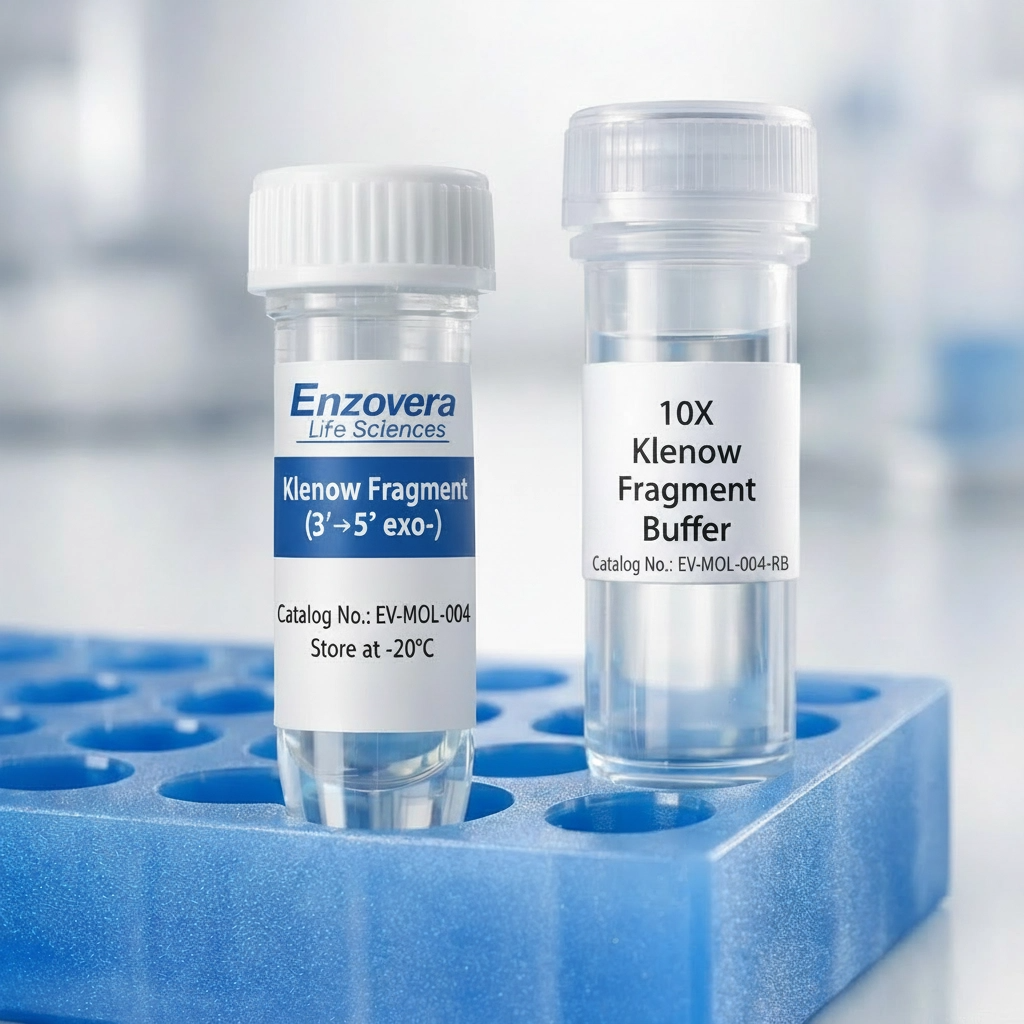
Klenow Fragment (3′→5′ exo-)
EV-MOL-004 Enzovera Klenow Fragment (EV-MOL-004) is an exonuclease-deficient recombinant derivative of E. coli DNA Polymerase I produced in E. coli BL21(DE3). It consists of the large C-terminal fragment (527 amino acids) with the N-terminal 5′→3′ exonuclease domain deleted and the 3′→5′ proofreading exonuclease abolished by two active-site mutations (D424A and E479A). The result is a pure, highly active DNA polymerase with no exonuclease activity of any kind — making it uniquely suitable for applications that require template-directed synthesis without any degradative side reactions.
Why exo-minus matters. Wild-type Klenow Fragment retains a 3′→5′ proofreading exonuclease that, while essential for fidelity in replication, is counterproductive in labeling and sequencing applications. In radiolabeling, the exonuclease competes with incorporation of labeled dNTPs, reducing signal and causing heterogeneous products. In Sanger dideoxy sequencing, the exonuclease removes chain-terminating ddNTPs, degrading the terminated fragments and reducing band resolution. The D424A/E479A double-mutant used in EV-MOL-004 completely eliminates both effects, enabling clean, efficient synthesis on any primed template.
Fill-in synthesis. Klenow Fragment (exo-) is the standard reagent for filling in 5′-overhang termini generated by restriction enzymes. The enzyme extends the recessed 3′-OH using the overhanging 5′ strand as a template, converting 5′ overhangs to blunt ends with high fidelity and without degrading the newly synthesized strand. For substrates with 3′ overhangs, T4 DNA Polymerase (EV-MOL-002) is the preferred enzyme, as Klenow exo- cannot remove 3′ overhangs.
Random primer labeling. Klenow Fragment (exo-) is the enzyme of choice for labeling DNA probes by random priming. Random hexanucleotides anneal throughout the denatured template, providing multiple initiation sites. Klenow exo- synthesizes from each primer incorporating [α-³²P]-dNTPs or non-radioactive labeled dUTP (e.g., DIG-dUTP, biotin-dUTP), generating high specific activity probes of 200–500 bp. The absence of 3′→5′ exonuclease prevents degradation of newly synthesized labeled strand.
Sanger dideoxy sequencing. Although largely superseded by capillary sequencing for routine applications, Klenow Fragment (exo-) remains the enzyme of choice for manual and specialized Sanger sequencing workflows. The exo-minus configuration eliminates competition between the exonuclease and ddNTP incorporation, yielding sharp, evenly spaced bands across all four dideoxy termination reactions.
Recommended applications:
Fill-in of 5′-overhang restriction ends for blunt-end cloning or ligation
Random primer labeling with radioactive or non-radioactive dNTPs
Sanger dideoxy chain-termination sequencing
Nick translation (in combination with DNase I) for probe generation
Second-strand cDNA synthesis in older cDNA library protocols
EMSA probe preparation via 3′-end fill-in with labeled dNTPs
Note: Klenow Fragment (exo-) is a mesophilic enzyme derived from E. coli. It is not thermostable and must not be used in thermocycling protocols. Optimal activity is at 37°C. The enzyme is compatible with all standard restriction enzyme buffers supplemented with dNTPs.