Phi29 Rolling Circle Amplification Kit
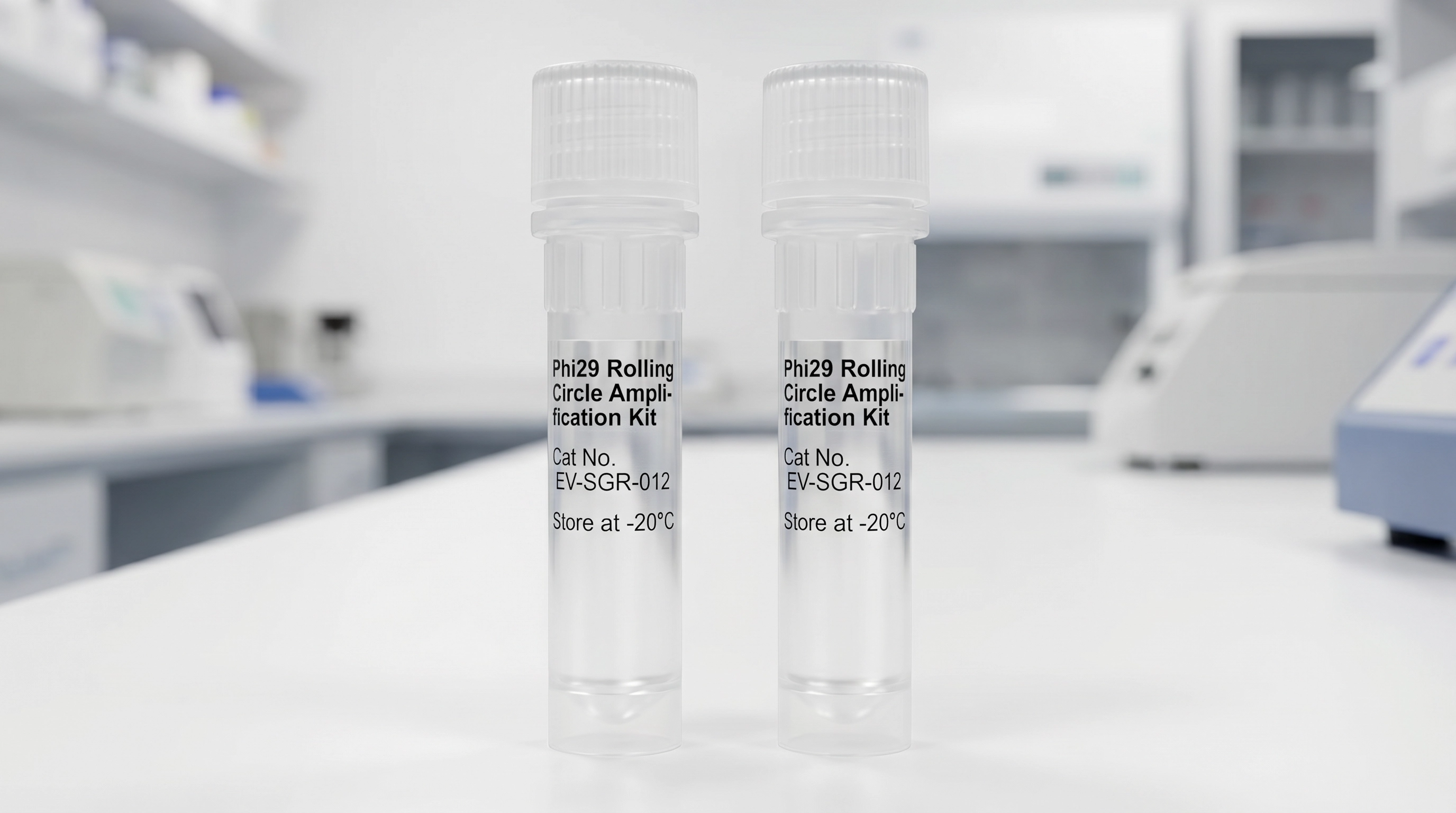
Enzovera Phi29 Rolling Circle Amplification Kit (EV-SGR-012) is an isothermal RCA-based kit using a Phi29 DNA polymerase mutant for amplification of circular DNA templates — including plasmids, BACs, minicircles, and circular PCR products — directly into sequencing-ready template, without bacterial transformation or column-based miniprep. The kit amplifies from picogram quantities of circular template to microgram quantities in 4–6 hours at a constant 30°C, providing a streamlined alternative to traditional cloning-and-miniprep workflows.
Mechanism of rolling circle amplification. Phi29 DNA polymerase is uniquely suited to rolling circle amplification: it has extreme processivity (>70 kb per binding event), powerful strand-displacement activity, and intrinsic 3′→5′ proofreading exonuclease for high fidelity (~10⁻⁶ error rate). When primed with exonuclease-resistant random hexamers on a circular template, the polymerase synthesizes a continuous concatemeric copy of the template, displacing downstream strands as it proceeds. The displaced strands in turn serve as templates for additional priming events, generating a branched, exponentially amplifying cascade — all isothermally at 30°C without thermal cycling.
From clone to sequencing in 4–6 hours. The standard RCA workflow begins with as little as 1–10 pg of circular template (equivalent to a single bacterial colony lysate, or 1–10 picograms of purified plasmid). After 4–6 hours of amplification at 30°C, the reaction yields 5–10 μg of high-molecular-weight DNA composed of concatameric copies of the input circle. The amplification product is directly compatible with cycle sequencing using VeraDye™ Terminator v3.1 (EV-SGR-002) — no purification step is required between RCA and cycle sequencing other than dilution and dilution of any residual primers. This eliminates the overnight bacterial culture and miniprep steps from the standard plasmid sequencing workflow, compressing a 2-day workflow into a single day.
Template scope and limitations. The kit is optimized for circular dsDNA templates from 1 kb to approximately 30 kb. Linear DNA templates are not amplified (the lack of a 5′ end prevents the rolling-circle mechanism). For linear template amplification, use a polymerase-based PCR approach with EV5™ High-Fidelity DNA Polymerase. The amplification product is concatameric (not monomeric circular), which is fully compatible with sequencing and most downstream applications but is not suitable for direct transformation back into bacteria.
Recommended applications:
- Plasmid template amplification for Sanger sequencing without miniprep
- Sequencing directly from bacterial colony lysate (pick-and-amplify workflow)
- Amplification of BAC and large-insert clones for sequencing
- Amplification of low-abundance circular templates including padlock probes and minicircles
- Sequencing of difficult-to-prepare templates that are unstable in bacterial hosts
- Rapid sequencing turnaround for cloning verification and construct validation
Pack sizes: 50 reactions and 200 reactions. Store at −20°C. Use exonuclease-resistant (phosphorothioate-modified) random hexamer primers — standard primers will be degraded by the Phi29 proofreading exonuclease.